The Fragrance Wheel
Have you ever used the fragrance wheel to purchase a new scent? Many of us use our sense of smell to determine whether we like a perfume or aftershave, but the fragrance wheel helps us see which fragrance notes belong in which category. Michael Edwards, a leading fragrance expert and consultant, created the fragrance wheel.

This article is part of a fragrance blog I built myself — I’ll explain how at the end if you’re curious.
In 1983, he developed the fragrance wheel, a visual tool for categorising fragrances by their dominant scent characteristics, making it easier to find a scent in a specific category.
Michael Edwards is well-known for his extensive knowledge of fragrance and expertise in the perfume industry. His creation of the fragrance wheel has become a widely used tool in the world of perfumery, helping both professionals and consumers understand and appreciate the diverse range of scents available in the market.

Understanding the Fragrance Wheel: Exploring Perfume Families and Their Unique Scents
The wheel is divided into four primary fragrance families, each further subdivided into subcategories. Each section represents a different scent type, and the relationships between the sections indicate how similar or dissimilar the fragrances are.
Perfume creation is a meticulous, artistic process that involves blending aromatic ingredients to craft a harmonious, appealing scent.
Floral: The largest category, including fragrances that primarily feature floral scents. It is further divided into subcategories like Floral White (white flowers such as jasmine, tuberose, and lily of the valley), Floral Green (green and natural-smelling floral notes), and Floral Woody Musk (floral notes combined with woody and musky elements).
Oriental: This category is characterised by warm, exotic, and sensual scents. It is divided into Oriental Soft (light and powdery), Oriental Floral (floral with an oriental base), and Oriental Woody (woody with an oriental base).
Woody: Fragrances in this family feature predominantly woody scents. It includes subcategories such as Woody Earthy (earthy and mossy), Woody Fresh (woody with a fresh, citrusy touch), and Woody Oriental (woody with oriental base notes).
Fresh: This category features crisp, clean, refreshing scents. It includes subcategories like Aromatic Fougère (herbal and fern-like scents), Citrus (citrus-based scents), and Water (aquatic and marine scents).

These four main categories can be further divided into more specific subcategories, comprehensively representing different fragrance types. The fragrance wheel helps consumers and perfume professionals understand a fragrance’s aromatic composition and find scents that suit their preferences.
Fragrance creators and marketers also use the fragrance wheel to identify market gaps and trends, enabling them to develop innovative perfumes that cater to different consumer preferences.
The fragrance wheel also helps create harmonious blends by identifying complementary scents across categories.
However, it’s important to note that the fragrance wheel is a guide, and some fragrances may not fit neatly into a single category. Perfumes often feature a combination of scents from various families, making them unique and distinctive.
Nonetheless, the fragrance wheel remains valuable in the perfume industry, facilitating communication and understanding among enthusiasts and professionals.
As a distributor for the perfume company FM World UK, I have used the fragrance wheel many times to help potential customers choose the right scent, especially when they want to try something new.
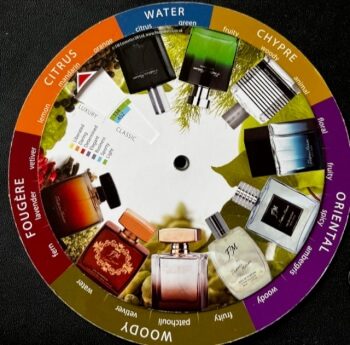
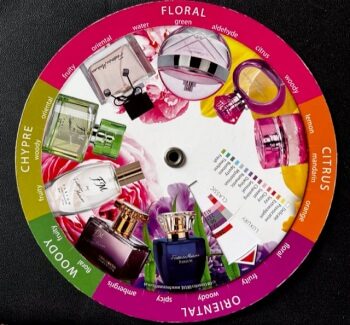
Sometimes we don’t automatically recognise which family a particular scent belongs to, so the FM World wheel has male and female sides. There is an inner wheel with an arrow that can be moved to a designated fragrance family, and then, within that selection, we can see which perfume numbers fall within that fragrance family.
It is also worth remembering that trying a perfume sample before purchasing is best to ensure it suits your skin type and occasion.
The Evolution and Art of Fragrance: From Ancient Rituals to Modern Perfumery
Fragrances, perfumes or scents have been essential to human culture for thousands of years. These aromatic compositions are designed to evoke pleasant sensations and stimulate our sense of smell.
Fragrances significantly enhance our identity, express emotions, and create lasting impressions on others. Many of us have worn fragrances since an early age, and some, like me, may have experimented with garden flowers when we were younger.
Related article: The Psychology of Perfume
The history of fragrances dates back to ancient civilisations such as Egypt, Mesopotamia, and India, where aromatic oils and natural ingredients were used in religious rituals, for therapeutic purposes, and for beautification.
As trade and cultural exchanges flourished, the art of perfumery spread to Greece and Rome, becoming an essential part of their societies.
Perfumery, the art of creating fragrance, involves blending various aromatic compounds to achieve an appealing, balanced scent.
Perfumers combine essential oils, aromatic extracts, synthetic molecules, and other ingredients to craft unique fragrances with different notes and accords.
Related Article: Ingredients In Perfume
These notes are categorised into three main types: top notes, middle notes (also known as heart notes) and base notes. The relationship of these notes over time creates the fragrance’s overall character and longevity.

Top notes are the initial, brief and temporary scents you smell immediately after applying a fragrance. They are light and refreshing, often made with citrus fruits or other bright, zesty ingredients.
Middle notes emerge after the top notes disappear and form the fragrance’s heart. They create the theme and personality of the scent, which can be floral, spicy, woody, or other distinctive accords.
Base notes are the foundation of the fragrance and provide depth and longevity. They typically contain rich, robust ingredients like wood, musk, or vanilla. These notes will last the longest in your perfume or aftershave and remain on the skin the longest.
How This Blog Was Created
Fragrances With Love started as a personal hobby — sharing my love of perfume, affordable finds, and fragrance trends. I didn’t start with a background in websites, marketing, or blogging.
This site was built by writing about something I genuinely enjoy. I use one platform to host my website, write my blog posts, and learn how to monetise content step by step, all in one place.
If you enjoy writing and have ever thought about starting a blog around something you love, you can see the platform I used to create this site below.
How I Created Fragrances With Love
Fragrances can be classified into several categories, such as floral, oriental, woody, citrus, and gourmand. Each category has unique characteristics that suit different occasions, seasons, and personal preferences.
Over time, fragrances have evolved, and perfumers continue to explore new ingredients and innovative techniques to create captivating scents.
The fragrance industry has also expanded to include various product forms, such as Eau de parfum, Eau de toilette, cologne, body sprays and scented lotions, catering to every individual’s needs.
Beyond personal use, fragrances have found their way into other industries, such as aromatherapy, where certain scents are believed to have therapeutic effects on mood and emotions.
Additionally, fragrances are used in household products, such as candles and air fresheners, to create pleasant living spaces.
Related article: Aromatherapy oils
Conclusion
Crafted by Michael Edwards’s expert hands, this ingenious tool has etched its mark on the perfume industry. It simplifies the complexities of aromas and creates a shared language for enthusiasts, professionals, and consumers alike.
Sign up for our monthly newsletter for the latest news in the perfume world, tips on what to do with your used candle jars and more.